
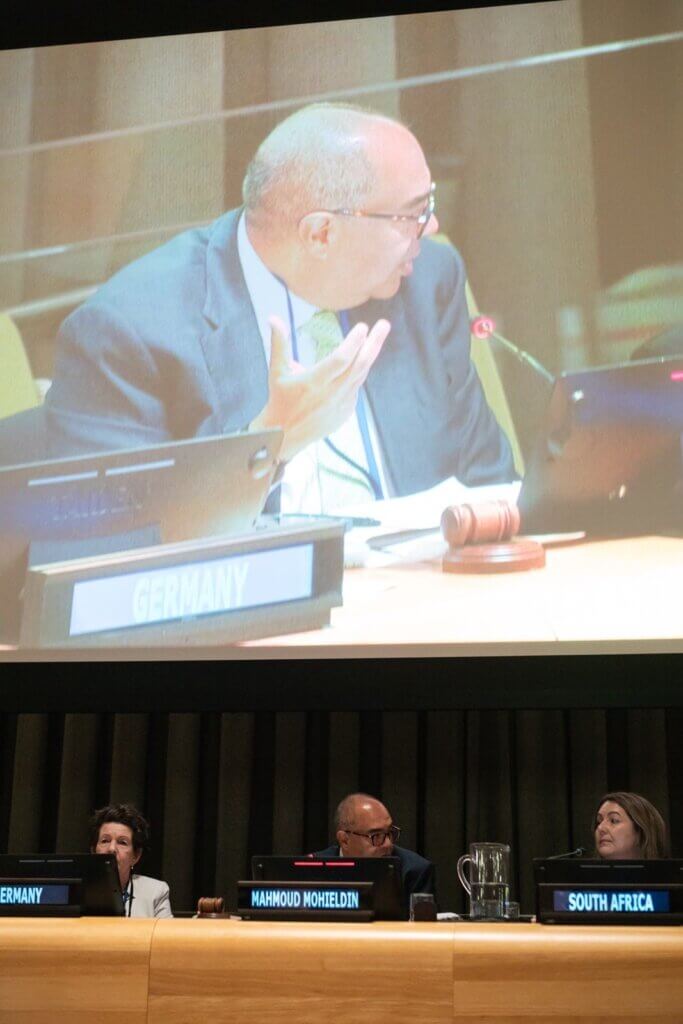
At the Finance for Development Forum at the UN, I moderated and contributed to a number of sessions on implementing the Sevilla Commitment — covering debt sustainability, international development cooperation, and domestic resource mobilization.
Session 1 brought together colleagues from South Africa, Germany, Norway, Brazil, and the ILO. South Africa presented early results from outcomes-based financing in employment programs — a model of national ownership that works. Brazil and others emphasized international tax cooperation and the real risks of fragmentation if political commitment isn’t sustained. The ILO focused on social protection financing and the need for deeper collaboration with international financial institutions. The cross-cutting lesson: clear outcomes, strong institutional coordination, and flexibility in partnerships are non-negotiable. Scaling remains the central unsolved challenge.
Session 2 I highlighted the need to address inefficiencies and fragmentation in current debt mechanisms, correct distorted risk perceptions in developing countries — particularly in Africa — and build stronger pipelines of investable projects that actually connect global liquidity to country needs. MDB acceleration is overdue. The Borrowers Platform is one concrete mechanism worth building on.
Session 3 — on localizing the 2030 Agenda — is where the conversation got most substantive.
”If it’s not in the budget, it doesn’t exist.”
Also, don’t waste time on endless discussions on the centralization vs. decentralization debate. And don’t wait for global policy frameworks to act locally — governance isn’t validated by reports. It is validated daily: is the school open? Is the service running? We are producing reports that have more authors than readers.
Mayors are expected to deliver across infrastructure, environment, social services, local development, urban planning, and civil society support — yet municipal finance remains an afterthought. Property taxes are a local instrument. Digitalization of local revenue systems is an immediate lever. Green smart pipelines — like what is being developed in Egypt on climate projects — show what’s possible when local priorities are properly resourced.
Five priorities I put forward: align local budgets with local realities; build green and smart investment pipelines; strengthen subnational data; use instruments like the Borrowers Platform to work around debt constraints; and implement without waiting for the global infrastructure to be perfect.
Four conclusions for leaders: localization must be central to everything we do; social cohesion at the national and local level requires real budget empowerment; speed is not optional; and whatever the outcome of the Sevilla Commitment reform process, implementation starts now.